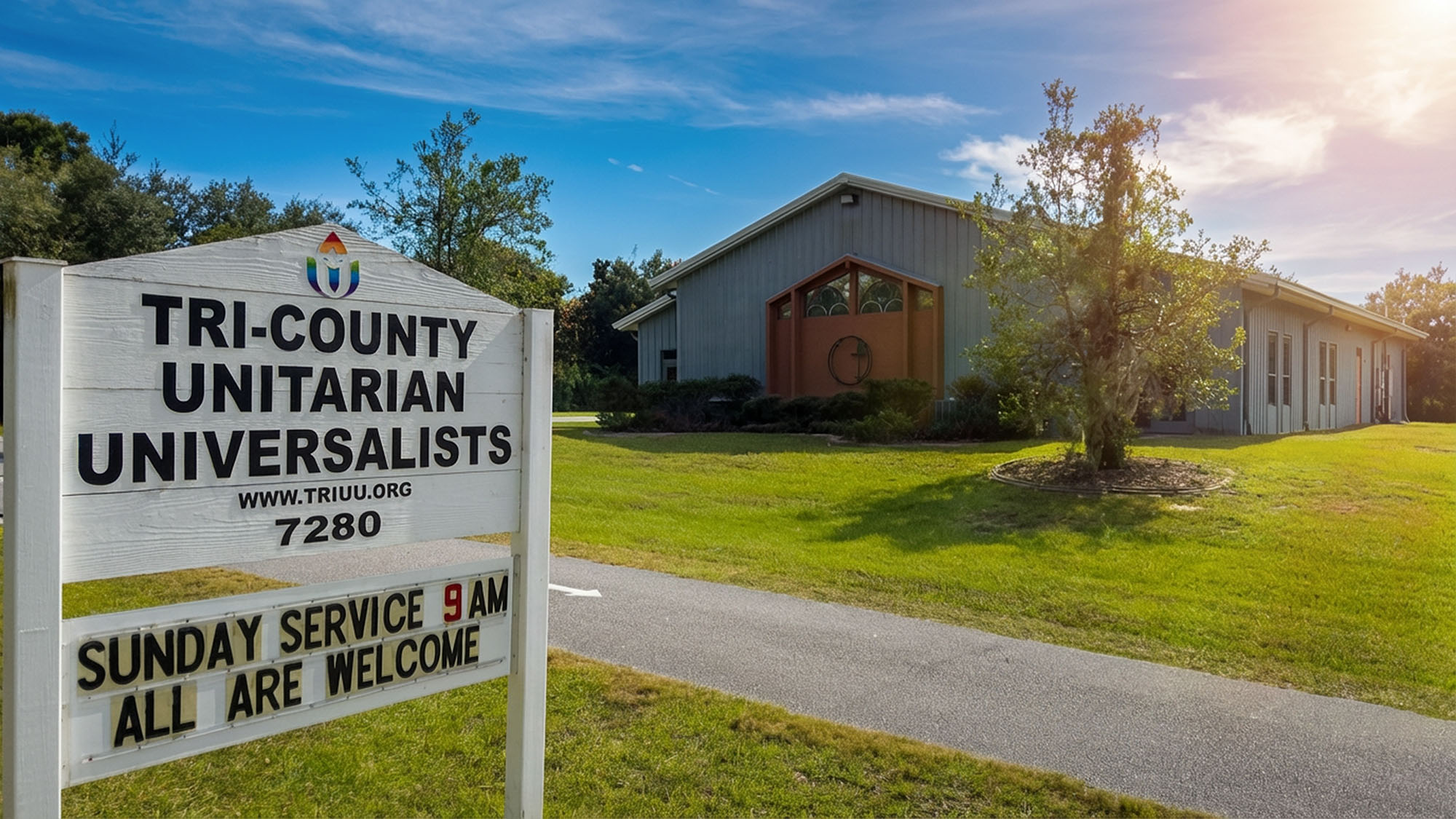
Our current home in Summerfield, Florida, opened June 2008
Our History
Since 1983, Tri-County Unitarian Universalists has been a home for liberal religious community in Central Florida. From a handful of seekers meeting in living rooms to a thriving multiplatform congregation, this is our story.
Every congregation begins with someone willing to gather strangers around a shared vision. For Tri-County Unitarian Universalists, that person was Felix Hirsch—an Ethical Culturalist who saw the need for liberal religious community in Marion County and spent a decade making it real.
Artist's interpretation
Felix Hirsch
Founder | Active 1970s—1986
In the 1970s, Felix Hirsch began gathering liberal-thinking Marion County residents for informal meetings—in homes, at the Ocala Library, even in a motel—to explore forming a Unitarian Universalist community. A member of the Ethical Culture movement, Hirsch brought its "deeds, not creeds" philosophy to these early gatherings, a spirit that still defines TriUU today.
His persistence paid off. By 1982, the group had grown enough to meet regularly, and in October 1983, the UUA officially welcomed the Unitarian Universalist Fellowship of Marion County into membership.
Hirsch's impact didn't end there. As a Silver Springs Shores resident, he discovered that the General Development Corporation had reserved land for religious organizations. He brought this opportunity to the fellowship, leading to the purchase of their first property and the 1986 dedication of their first building.
While Felix Hirsch planted the seeds of community, other leaders helped the congregation take root. One whose impact endures to this day is Muriel Bingley.
The stained glass windows, donated by Muriel Bingley. Originally from St. Mark's Catholic Church in Bottineau, North Dakota—restored by her husband Emery.
Muriel Bingley
Board of Trustees Member and President | Stained Glass Donor
Muriel Bingley served on the Board of Trustees, both as a member and as its President. She was president during the sale of the Silver Springs Shores building and the congregation's move to Summerfield.
Her most visible legacy hangs in the Chancel today: the stained glass windows. Originally from St. Mark's Catholic Church in Bottineau, North Dakota, the windows were rescued when that church discarded them. A priest friend told Muriel's husband Emery he could take them. Emery restored the windows and hung them in their home. When Muriel relocated to Florida, she brought them with her—and eventually donated them to the congregation.
The windows have since influenced decisions about paint colors for both the building exterior and Sanctuary interior—a testament to how one person's gift can shape a community's identity for generations.
Muriel later left a bequest to TriUU, continuing her support of the community she helped build.
1970's — 1983
In the 1970s, a few liberal-thinking Marion County residents began seeking each other out. Led by Ethical Culturalist Felix Hirsch, they arranged sporadic public meetings for prospective Unitarian Universalists—gathering in homes, a motel, even the Ocala Library.
Hirsch's gatherings began as a great books discussion. Among those early seekers were four who would become charter members: Felix and Ann Hirsch, and Jim and Dottie O'Hara.
Finding a room was its own work. More than once a landlord welcomed the fellowship, learned what Unitarian Universalists believed, and asked them not to come back after a single meeting. Dottie O'Hara was the one who kept finding the next room—Cherokee Park among them.
In 1982, the group invited Sid Peterman, UU Inter-District Representative, to discuss affiliation with the Unitarian Universalist Association. He encouraged them to keep growing—twelve members were required to apply—and to establish a regular meeting schedule.
They decided to begin with a picnic on August 29, 1982, in Cherokee Park in Belleview. Attendance was usually six to eight people.
By June 1983, the group had grown enough to meet twice monthly, gathering Sunday evenings at the Friends Meeting House in northeast Ocala.
October 22—23, 1983:The UUA Board of Trustees voted to receive the Unitarian Universalist Fellowship of Marion County into membership. The congregation was official.
1983 — 2008
Four Moves in Two Years
Between October 1983 and February 1986, the young fellowship moved four times. Each location presented new challenges—and each challenge strengthened their resolve to build a permanent home.
October 1983 — UUA Acceptance
The Unitarian Universalist Fellowship of Marion County is officially welcomed into the UUA.
Cherokee Park, Belleview
The fellowship's first regular Sunday morning home following UUA acceptance.
Why they left: the building did not allow children, and families joining the fellowship wanted a religious education program.
Trinity Villas, Ocala
A brief stay—just two services. Days after the second, the fellowship received a phone call: their UU beliefs made them unwelcome.
Why they left: asked to leave due to the fellowship's religious beliefs
Silver Springs Shores Community Center
A shared facility divided by a wall from another congregation. The neighboring group's enthusiastic worship made it difficult for members to hear speakers or one another.
Why they left: sound from neighboring congregation made worship difficult
Silver Springs Shores Youth Center
A more practical space, but one that required members to clear recreational equipment before each service and restore it afterward for weekday programs.
Why they left: required setup and teardown around equipment each week
February 9, 1986 — Building Dedicated
The fellowship dedicates their first permanent home on land discovered by founding member Felix Hirsch through the General Development Corporation.
Building Their Own
By 1985, the fellowship had had enough. Felix Hirsch, a Silver Springs Shores resident, learned that the General Development Corporation—the land developer that created Silver Springs Shores and other Florida planned communities—had reserved parcels for religious organizations, a common practice that helped new communities attract families. He brought this information to UUFMC members, who made the decision to purchase property and build.
UUFMC purchased a one-and-a-half acre lot (Tract G, Unit 9) for $12,000. They found a contractor willing to build for $36,000 because the fellowship agreed to do all painting, landscaping, finish work, and purchase flooring and appliances themselves.
The I-75 Donut Story
The congregation needed to raise money beyond the $20,000 UUA loan. Members and friends contributed personal funds, held bake sales and auctions, and found a unique opportunity: the county's "Safety Break" program let groups sell coffee and donuts at I-75 rest stops.
With donated donuts, congregation members staffed rest stops three times a week for six months.
They raised $2,500.
Fundraising at an I-75 rest stop—three times a week for six months
A New Chapter — Moving to Summerfield (2003—2008)
By the early 2000s, the Silver Springs Shores location presented a challenge: the area wasn't growing, and the church was hard to find. Half the membership by then lived near The Villages—the largest retirement community in the country—and charter member Dottie O'Hara had noticed that most of the congregation's visitors were driving in from there as well. She argued that the congregation should move south to meet them. The congregation made a bold decision: sell the building they had built with their own hands and start over closer to where the people were.
1986—2003
First Permanent Home
The fellowship worshipped in their Silver Springs Shores building for nearly two decades. The mortgage was paid off by 1990—and the congregation began looking toward new possibilities.
May 2003
Buying Before Selling
The congregation purchased two acres of land in Summerfield (later expanded to 3.46 acres). For two years, they owned both properties—managing the financial complexity of dual ownership while planning their new home.
2005—2006
Back to Cherokee Park
In 2005, they sold the Silver Springs Shores building (the buyer later became Iglesia de Jesucristo El Buen Samaritano) and went back to where the congregation had begun: the recreation room at Cherokee Park in Belleview—the same park where six or eight people had held a picnic in August 1982. The rent was eight dollars a week. Members set up the chairs before every service and swept the room afterward, carried in a coffee pot each Sunday, and shifted around the posts that blocked the view of the speaker. There was no minister, so a different guest speaker came each week—and when a speaker did not arrive, a member read aloud from a file of sermons another member had copied and kept for exactly that reason.
c. 2006—2008
The Elks Lodge Years
As visitors and membership outgrew the park, the congregation moved to an Elks Lodge on Route 25, a mile or two east of Belleview—since closed. Member Margaret Dawson, an Elk herself, arranged it. They worshipped there while construction proceeded.
June 2008
Coming Home
The congregation held its first service in the new Summerfield building. The total project cost was approximately $408,500—a remarkable achievement for a congregation of around 53 members.
A Community Investment
Rather than seeking traditional bank financing, the congregation created an innovative solution: a member-held LLC where congregants could purchase shares in their future building. Each share cost approximately $1,000 and paid 4.5% interest quarterly—allowing members to invest in their spiritual home while earning modest returns.
This community-driven model echoed the grassroots spirit of the first building, when members sold donuts at I-75 rest stops. Instead of spare change from travelers, this time the investment came directly from members' savings—a profound act of faith in the congregation's future.
A Living Legacy
The member-share model created an unexpected challenge decades later. As original shareholders passed away, their children—many living far from Florida—inherited pieces of the church mortgage. Non-members now owned portions of the building.
In 2024, member Barbara Woodson jump-started a campaign to bring the mortgage back under congregational control, purchasing ten shares from heirs. Twenty-two members followed her lead. This ongoing effort ensures that TriUU's financial future remains in the hands of its community—the same spirit of self-reliance that has defined the congregation since its founding.
Melody Meadows
Behind the building, past the hedgerow, the property keeps going. That strip is what the congregation calls Melody Meadows, and the name is not decorative.
By the time the adjoining land came up for sale, membership had grown to between 100 and 120 and the congregation was thinking about expansion, so it voted to buy—taking the Summerfield property from two acres to 3.46. The loan on that purchase was paid off by the music program: the choir and the Solberg family, led by choir director Al Solberg.
The music people bought the meadow. That is why it is called Melody Meadows. Gopher tortoises live there, and TriUU's Memorial Garden Team, which works the meadow, has found more of their burrows.
Ministers
Throughout our history, ministers have shaped who we are—from seasonal visitors who planted seeds, to our first settled minister, to student ministers we helped train, to community ministers whose work extends far beyond our walls.
Early & Seasonal Ministers
Early in the congregation's history, Rev. J. Robert Bath, a retired UU minister from Maine who wintered in Florida, was actively involved during his Florida seasons. Rev. Bath provided excellent programs which resulted in increased attendance and growth in membership. In November 1986, Rev. Bath and his wife Phyllis notified the congregation they would no longer be wintering in Florida—a significant loss for the young congregation.
Sid Peterman
UU Inter-District Representative
Helped the congregation pursue UUA affiliation in 1982
Rev. Jack Donovan
Weekend Minister, Beginning 1987
Trained at Starr King School for the Ministry in Berkeley, California, Rev. Donovan served as the settled minister at UU Fellowship of Gainesville for over 25 years. During that time, he provided part-time ministerial support to UUFMC, visiting a few weekends each year to lead Sunday services and participate in Board meetings, orientation programs, and committee work. Rev. Donovan later served the UU Church of St. Petersburg (2014—2021) and remains active in retirement.
The DeWolf-Hurts
In 1988, John and Mary Louise DeWolf-Hurt moved to Silver Springs Shores as the new Co-District Executives for the UUA's Florida and Mid-South Districts. During their two terms, they helped establish new congregations across the region, including the UU Church in the Pines in Brooksville.
John's unexpected death from pancreatic cancer in 1996 cut short their ministry partnership—but it also awakened Mary Louise's calling to parish ministry. In September 1997, she asked the congregation to sponsor her preparation for UU ministerial fellowship. The congregation voted to approve on September 14, 1997.
Rev. Mary Louise DeWolf-Hurt was ordained at UUFMC on June 3, 2001. She later served as part-time minister at Nature Coast Unitarian Universalists in Citrus Springs (2003—2009), where she was named Minister Emerita.
Rev. John DeWolf-Hurt
District Co-Executive, 1988—1996
Served two terms as Co-District Executive for Florida and Mid-South Districts. Died unexpectedly from pancreatic cancer in 1996.
Rev. Mary Louise DeWolf-Hurt
Sponsored 1997; Ordained June 3, 2001
Following John's death, pursued her calling to ministry with UUFMC's sponsorship. Later served Nature Coast UU (2003—2009); named Minister Emerita.
Called & Settled Ministers
Rev. Janet Onnie Minister Emerita
Consulting 2010—2013; Settled 2013—2021
First full-time settled minister in the congregation's history. Retired to Virginia in 2021; voted Minister Emerita by the congregation
Rev. Cynthia Snavely
Interim Minister, 2021—2024
Guided the congregation through the post-COVID transition period
Rev. Kristina Spaude
Contract Minister, 2024—Present
Shared ministry with UUCLC (Eustis congregation); began August 2024
Community Ministry
TriUU has served as a congregation of record for community ministers—UU clergy whose primary ministry takes place outside congregational walls, such as in hospitals, hospices, or international humanitarian work. This formal relationship provides accountability and spiritual grounding while the minister serves in specialized settings.
Rev. David Etherington
Community Minister (Congregation of Record), 2014—2020
A second-career minister who practiced law for 28 years before ordination, Rev. Etherington served as a hospice chaplain at Haven Hospice in Gainesville while TriUU provided his congregational affiliation. He also served multiple terms with the Ecumenical Accompaniment Programme in Palestine and Israel (EAPPI), a World Council of Churches program monitoring human rights conditions in the South Hebron Hills. Rev. Etherington spoke at TriUU about his observations and experiences, connecting his international witness work to Unitarian Universalist values.
Teaching Congregation
TriUU has served as a teaching congregation, providing hands-on ministerial training for students preparing for UU ministry.
Rev. Tracie Barrett
Student Minister, May 2015—2017
First student minister; ordained by the congregation in 2017
Rev. Christine Dance
Ministerial Intern, 2018
Second ministerial intern; now serving her first ministry in Phoenix, Arizona
Rev. Joe Donatone
Ministerial Intern, 2018—2020
TriUU's third and longest-serving student minister. A graduate of Iliff School of Theology in Denver, he brought a focus on recovery spirituality and LGBTQ+ advocacy. When COVID-19 hit during his final months, Donatone worked with Rev. Onnie to launch Zoom services and trained the Tech Team that still enables multiplatform worship. Ordained in 2020, he now serves as a VA hospital chaplain in Cleveland, Ohio.
Moments That Define Us
1987 — Denominational Leadership: Congregation member Jim O'Hara, appointed as representative to the Florida District Northeast Cluster, was asked to serve on the Florida District Board. He became District President that year. Jim and his wife Dottie also contributed to worship life, working to bring recorded hymnal music to services during a period when the congregation's pianist was unable to play.
First in Florida: Marriage Equality
January 2015 — TriUU (then UUFMC) became the first church in Florida to perform same-sex marriages.
This milestone reflects the congregation's longstanding commitment to dignity for all people and the courage to live our principles in the wider world.
March 2017 — A New Name
Understanding "Fellowship": When the congregation was founded in 1983, it called itself the Unitarian Universalist Fellowship of Marion County. The word "fellowship" carried specific meaning in UU history: during the 1940s through 1960s, the denomination promoted the "Fellowship Movement," establishing small, lay-led congregations that intentionally operated without professional ministers. These groups spread Unitarian Universalism across the country, including to Marion County.
A New Identity: At the congregational meeting in March 2017, members voted to change the name to Tri-County Unitarian Universalists. The change reflected three realities:
Geographic growth: Membership now spanned Lake, Sumter, and Marion counties
Evolving identity: With a settled minister since 2013 and decades of institutional development, the congregation had grown beyond the small, lay-led fellowship model
Choosing our story: As Rev. Kristina Spaude notes, the distinction between "fellowship" and "congregation" is largely about self-perception—how a community chooses to define and present itself
The word "congregation" emphasizes the people rather than a building—fitting for a community that spent its first years meeting in parks, living rooms, and borrowed spaces before building a home of its own.
2020 — Present
When COVID-19 struck in 2020, the congregation followed UUA guidelines and closed the sanctuary. Within weeks, TriUU had transitioned to Zoom Church.
Rev. Janet Onnie and ministerial intern Joe Donatone were instrumental in transitioning services to Zoom. During the shutdown, the congregation offered five weekly Zoom gatherings; one of them—"In the News," a Tuesday afternoon discussion of current events—continues to this day.
When Rev. Snavely arrived as interim minister, the congregation held one in-person service before returning to Zoom for four months. Since then, with the Tech Team that Donatone trained before his departure, TriUU has offered multiplatform services every Sunday—welcoming both in-person and online participants.
In the 1980s, the young fellowship left Cherokee Park specifically to make room for children's religious education. Four decades later, the congregation has adapted to a different reality.
Located five miles from The Villages—the nation's largest retirement community, where 85% of residents are over 65—TriUU now focuses on adult faith development. Offerings include Chalice Circles for spiritual reflection, the weekly "In the News" discussion group, the long-running "Great Decisions" foreign policy series, book clubs, and monthly forums with guest speakers.
Children remain welcome in Sunday services, and families can access UUA curriculum resources for home use. But the congregation's educational mission has evolved to serve the community it actually has—a shift that mirrors trends across Unitarian Universalism, where the denomination has moved toward "Whole Church" models of lifelong faith formation.
Who We Are Today
From the six to eight people who gathered in living rooms and libraries in the 1970s, TriUU has grown to a congregation of around 100 members—plus many others who participate without formal membership. Full-time residents and seasonal Floridians alike call TriUU home.
Today, Tri-County Unitarian Universalists continues to grow as a welcoming spiritual home in Central Florida. We gather in person and online, bridging distances and generations. We remain committed to the values that brought a handful of seekers together in the 1970s: freedom of belief, dignity for all people, and the courage to live our principles in the wider world.
Wherever you are on your spiritual journey, you are welcome here.